Search This Blog

Thursday, April 22, 2010

New computer setup

So i got my new computer, a Dell Studio 17 inch at the beginning of the month. As a result I was also able to connect my new monitor, a 23 inch LG.

Old setup:
*It wasn't exactly there. That's just where I keep it till my dad cleans up his work crib in the basement and is ready to adopt the homeless HP.

New setup:

-- G-raph Out --

Wednesday, March 10, 2010

Blogs aren't really my thing for now

These few weeks i won't have time to update this, but my Twitter will be updated more, which you can check on the right side.

-- G-raph Out --

Monday, March 1, 2010

DIY digital 3D magnetometer

Finally had the time to put everything together into a nice PDF. Just to remind you, I was not allowed to use micro controllers or interface it to a PC. When you reach the diagram section in the PDF, you will see two of them. Thea reason for this is (you'll know this if you skim over the explanations) that a toroid could only be used to detect the magnetic field on two axis. Hence the first diagram has one drive coil and two sense coils and two display, while the second one has only 1 drive, 1 sense and 1 display. Initially i intended to make it have 3 displays that would show all the axis in real time. When 2 days before the darn thing was due, I failed in printing my own hand made circuit board (the etch-resistant pen was at fault since it wasn't resistant enough), i tried to fix the mistakes through the silver containing conducting paste. Didn't work out. Therefore the design was changed so that we would only use 1 display, which meant hooking up a 3 way switch (3 in, 1 out) or 2 2 way switches(imagine a normal slide switch put in a binary tree  fashion).

There was a way to use only 1 coil, but that involved buying a tall toroid. Unfortunately that had to be custom ordered, and it took to long. that also meant between noise filters had to be developed and i didn't have time to do it.

-- G-raph Out --

Canada vs USA ~ Canada wins

First of all the game. It was unbelievable. It was well plaid, and there almost was a hockey fight, which was expected considering the pressure of the game. 1-0 at the end of the 1st, 2-1 at the end of the second and 2-2 at the end of the 3rd after Team USA scored with 28 seconds left. Who would have thought it was even possible?

Then we went into 20 minutes of sudden death with shoot-outs afterwards if needed. And Sid the Kid won the game. He saved the best for last. Some were complaining about his lack of scores in the 3 previous games. But in this winning play, he pushed and didn't give up. And because Canada won the Hockey gold, Canada won the Olympics.  Of course USA and Germany had more medals (not gold though), but it was the hockey game that decided who really won the 2010 Vancouver Olympics.

Before Sid's shot, no Canadian dared to think what if the US won. It would have killed our Canadian pride. People would turn in their citizenship and I would not apply for one. The fabric of space and time would have ruptured. This was our sport.

This following article details the true meaning of this game in a way that i could not do without plagiarizing. So here it is:
http://sports.yahoo.com/olympics/vancouver/ice_hockey/news?slug=jp-hockey022810&prov=yhoo&type=lgns


-- G-raph Out --

Thursday, February 4, 2010

Programming project

I've been thinking lately of doing the science fair this year. That depends if i do get time to write the program. What I basically want to do is to create a augmented reality program. The idea is that you will have a camera at the front of a car, which will take a live stream of everything in front of the car. The program will read the license plates and will pull up information about the driver from a database. It won't be name and DOB and that kind of stuff. It will rather be any infractions the person committed, so you would now if the driver in front of you has had a history of DUI or hit and runs. It could also tell you whether the car is stolen or not so the proper law enforcements could be contacted. 

I guess at the end more features can be added. This would include methods to figure out the lights at the intersection for example.

However, there are some problems with my original idea. While for most cars the license plate is clearly visible, there are some cars where the paint is faded. This could be solved by replacing the reading of the license plate with a piece of hardware in each car that would transmit its license plate and all this other info to all the cars around it in a 10m radius. Then the info could be displayed in the corner of an HUD on the windshield. I looked into HUD displays, but something that big seems a bit hard to do. There are some alternatives though. At CES, this year, I think it was Sony that had a laptop with a transparent display. The colors were incredibly vivid for the 40% transparent display. I guess you could put the same thing instead of a windshield. It would definitely occupy a lot less space than an HUD, as for an HUD you need a projector as well.

I think for the purpose of the science fair I will stick to my camera version, and assume that the license plates are visible. Well actually I have no idea, as in order to see the cars in front of you, a high-res picture will be needed, so OCR should take some time on it. This would make everything lag quite a bit, so in the end IF i am to do it, I'll stick to hardware. I haven't thought that much about that, so no idea how i'll realize that in terms of protocols. Bluetooth maybe since most new cars have that anyway? Not sure about the radius of the blue tooth though

-- G-raph Out --

Sunday, January 31, 2010

Popular Mechanics links of the Day

Today I found these great articles on PopMech. First one (http://pburl.com/0ef708) deals with robots. It is this month's cover page issue for their magazine. It's brilliantly written, full of interesting information. There is also this idea which keeps bugging me for some time. Why do all of our robots have small motors in them? Why couldn't we instead make their movements happen because of different fibers stretched the same way muscles are? The material would need the property to contract when current is sent through it and TA DAA: more human robots. I know that some scientists in the US are working on these kind of fibers made of carbon nano tubes., but is there any other material or even gizmo that does the same thing so that we could play with it for a while? If it is and if it is relatively cheap, please tell me about it in the comments, as I am very interested buying it, for a miniature robot working on the principle above.

2nd article: http://pburl.com/074d1f. Mr Richard Branson comes up with another great idea. The type that is described best by *face slap*-why-didn't-I-think-of-that? He reached the space, and now he is planning on getting a line of submarines, so people could go deep under the oceans whenever they want to, or on chartered dives through Virgin Seaways.

3rd article deals with Nasa's future. http://pburl.com/050c29. It seems that uber-cool president Obama, did not include any money for the hardware for Nasa's human space flight program in the budget. This raises the following question answered by the article:

  • 1) Who are the beneficiaries of this budget shift? 
  • 2) Is the military the heir to NASA? 
  • 3) Will the U.S. lose the new Space Race? Do people care? 
  • 4) What will the next big launch vehicle look like? And when will it be ready? 
  • 5) Are NASA astronauts going extinct? 


-- G-raph Out --

Friday, January 29, 2010

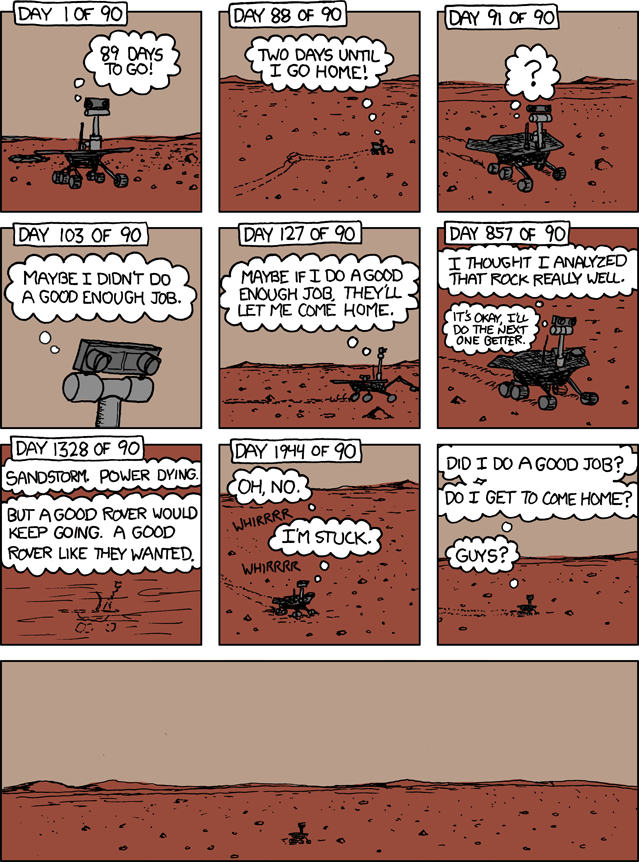
Saddest XKCD post

Awwww...


Please go to the website below, and see the mouse over text:
http://xkcd.com/695/

-- G-raph Out --

Wednesday, January 27, 2010

WEP Passwork Cracking w/ BackTrack 4 VIDEO


I am not to be blamed if you get in trouble.

-- G-raph Out --

Tuesday, January 5, 2010

Manipulating bitmaps

Today I started to learn Processing and openFrameworks. I know C++ and Java, so you can say that I basically know these languagese as well. However I've noticed that they are used quite a bit in Microcontrollers, so I decided to give them a try to see what they have different that makes them suitable for this. Thus I decided to write some small apps, through which I would learn how to play around with MIDI files and images, while learning the above mentioned languages

So the first program in in Processing, and it applies a convolution filter. What is does is that when applied to he entire image, it leaves only dark pixels that are surrounded by other dark pixels. All the rest are changed to white.

Code is here


-- G-raph Out --

Tuesday, December 29, 2009

Helicopter Project

Next semester I am planning on building a helicopter type thing with 2 ducted fans VTOL. Basically they will look the same way the Scropion or the Samson gunships looked in Avatar. As a processing unit, I am thinking of getting on of those small computers that has a processor and some ram and runs linux. I forgot what the name of those things are, but I remember that I saw some when I went to UTIAS (University of Toronto Institute for Aerospace Studies) for a school trip. Does anyone know what I am talking about to tell me where could I find one of those? Ideally, I will also make them able to fly in a squadron, where one is the leader and the rest mirror the leader's moves,w hen the right time comes. I could then add extra weight to one of them or  control the maximum degree of fan turn, and make it auto compensate, so that in the end it will follow the leader's path. 


When I say that they will mirror the leader, I am not saying that the actions, as in commands, that the leader does will be copied by the rest. I am talking about the end result to be the same. The extra parameters might be a bit hard to implement, so I guess that won't be done till the end of the year. This will probably be my first complex project, where I will build everything.

-- G-raph Out --

Wednesday, September 2, 2009

Sunnybrook 3D code

Hey,

This is the unoptimized code that I worked on for Sunnybrook. I actually don't have a copy of the optimized one. The only difference are some OpenMP functions here and there that would do the cluster optimizations.

Code

Sometime this week I will explain what the code actually does, and I'll explain the whole thing in more detail. I think I might also post some preliminary code that I wrote to understand the math. That code is the 1D version of this in C++, and Matlab.


-- G-raph Out --

Tuesday, September 1, 2009

Ap Physx Labs Posted

Today we just found out the labs we will have to do this year for AP Physics (from here on I will spell it Physx (Yes I got that from Ageia Physx)).


  1. Soup Can Roll
  2. Collision Simulation
  3. Simple Pendulum
  4. DC Cicuit Analysis and AC Inctroduction
  5. AC Circuit Analysis

-- G-raph Out --

Simple Pendulum Lab Instructions

You are to investigate the effects that bob mass and the length of a pendulum have on its period. This is to be done at various release angles and the effect the release angle has on the pendulum’s period must be modelled.

The differential equation for the motion of the pendulum must be derived and the constants measured. For small values of theta, the DE can be simplified using the small angle equation. You must, however, be prepared to defend what range you consider a small angle and how this estimation affects the overall precision of your work. You are also expected to empirically model the effects of large values of theta on the period. Thus your final expression will be something like Period(theta, Length) = Ideal Period(length) + Period Perturbation (theta, length). CAUTION: Observe that the square root of small g is essentially equal to Pi. Do not ignore this!

Soup Can Lab Instructions

 You must use two cans of soup. One is a consommé and the other is a cream soup. The cans must have the same-labelled mass and have the same dimensions at least to eye. It is better if the soups chosen do not have chunks of material in them.

These cans are to be rolled down two ramps and then on to a flat surface. The slope must be otherwise smooth and so must be the floor. One slope is to be slight permitting the consommé can to roll further. The other must be much steeper and result in the cream soup rolling further. You may have to cover the slopes with some material to prevent the can from slipping. You may also modify the floor ramp interface to allow the can to smoothly transfer from the ramp to the floor without appreciable bouncing. (If you think this matters)

Friday, August 21, 2009

About Me

Hey,

I was born in 1992, (August 14 to be more exact), to my mom and dad in Braila, Romania. My parents were actually living in Bucharest, but since my maternal grandparents live in Braila, and my maternal grandfather was the head of the Hospital in the city, my mom gave birth to me there. The history was going to repeat itself five years later with my sister. Now, you must understand the setting in which I was born. It was 2 years and a half since the fall of communism in December 1998. I guess that by being born in an ex-Commie country, I lost all my future republican supporters. Meh, I’ll make up to you guys some time later. So, as I was saying I was born in Braila. There was nothing special about me at birth as I was about average. For the next three years I lived mostly in Braila. Those were probably the best three years of my life. From the day I was born, I also started to grow, reaching a full 1 meter when I was one. My suspicion is that the hospital must have tested a mushroom power up and now I was the Big Alex. Or I might have just got the genes from my maternal grandfather. To put it in perspective the average kid is anywhere from 0.7 meters to 0.8 meters when they are 1. Funny story about my life as a one year old, is how people would ask my mom/grandparents if I was not too old to still be in a baby carriage. They would also try to talk to me, but I did not know what to say back. These two factors + my height made people think I had some kind of handicap.

Thursday, August 13, 2009

Forgot to metion

Forgot to mention that this summer, I am also working for the first time in my life. And no, I am not flipping burgers, although if done properly by actually thinking about the physics of flipping burgers, you could get some pretty nice results.

My first job is in research actually, at Sunnybrook Health and Sciences Center in Toronto. More exactly at the Ultrasound Lab. I've been working here since the beginning of July, and I am already done my first project which was to install and configure a 10 computer based cluster. It took me a bit longer then expected, as I had to learn Linux (always wanted to do it, never had a reason or time to). The end configuration was with Cent OS as a linux distro, Perceus as a cluster management program. They already had another cluster with warewulf, but they needed another cluster. So the new cluster also acted as a test platform for the Perceus software, as we couldn't really afford any downtime with the cluster running warewulf, so we wanted to see that everything is fine, before making a transition. As a resource manager I installed Torque, as they didn't want to actually pay for any of this software.

My second project is writing a program to numerically solve the Bioheat Equation in 3D. What I did until know, is that I wrote it for 1D in Matlab, and 1D in C++, now working on the 3D C++ version. Once I am done this I'll have to do a 3D Matlab version as well.

The work they are actually doing there consists of trying to fry or damage tumors using ultrasound and microbubles. For frying the idea is relatively simple and consists in focusing a ultrasound wave on a small surface, thus heating it up and frying it without trying to damage too much of the rest of the tissues. Another way is trying to inject microbubbles into the tumor area, and then ultrasounding it, which will make the microbubbles oscillate and change size hitting the tumor in the process. This will have the same effect as really small punches to the tumor, which will hopefully break it apart.

So this is pretty much my summer, with an 8:30 to 4:30 program, which I actually like. Too bad Sunnybrook hospital doesn't have a Gallery, so that we could see surgeries during lunch.

-G-raph out-

Hello and AP results

Welcome everyone,

This is the first post of this blog. Now the stuff that will be published on this blog, if I don't get too bored of constantly updating it, will be related to all the electronics projects I'll do + any other personal stuff that still relate in some way to Electronics and Physics and Math.

And by that I mean my AP scores for example, where I got a 4 on Calc BC and a 5 on Comp. Sci. AB.

I actually expected it to be the other way, with a 4 on Comp Sci and a 5 on Calc. But I can't complain as the schools that are accepting AP exams and that I am interested in, like this mark combination as well.

-G-raph out-

Friday, January 2, 2009

Collision SImulation Lab Instructions

You will write a simulation using code in C, C# or C++ that will simulate a two dimensional collision.

This code will first verify itself solving a 2D collision that is first head on with a motionless target, then a glancing collision with a motionless target. The verification is taken from a photocopy of a worked problem or an example from a text book that will show conclusively that your program is producing comparable results